Jorgen Knudsen
The ChangelingJorgen Knudsen is the aging head of a Queens family whose inherited pact with a hidden creature has been sustained by the sacrifice of children. He is at once its caretaker, a guilty witness to generations of harm, and a father who still tries to protect his son. His encounter with Apollo Kagwa turns a family history into a choice about what fatherhood permits—and ends with Apollo killing him.
Identity and Introduction
Apollo comes to Jorgen’s home at 124 86th Road in Forest Hills while searching for William Wheeler. Patrice Green has identified Jorgen as the person to contact because the boat Apollo and Patrice once used was registered to him. Patrice suspects William gained access to it improperly, but hopes Jorgen may have information that will help Apollo find William. The address therefore leads Apollo to a possible source of practical help, not at first to the history of the Knudsen family.
The man Apollo meets has wild white hair and has been drinking. He gives his name as Joe, explaining that people in the United States call him that because, as he sees it, an immigrant’s name must be convenient or changed. When Apollo calls him Jorgen Knudsen, he briefly becomes rigid before returning to his weary manner. That moment exposes a difference between the familiar name he uses publicly and the family identity that Apollo has come to investigate.
Their first conversation takes place in Jorgen’s kitchen. A large pot containing a sheep’s head is cooking, and he directs Apollo to core a cabbage as though supervising a grandson. A serrated utility knife lies on the cutting board; Apollo takes it while remaining alert to the possibility that he may need to defend himself. Jorgen’s domestic routine and the danger in the room occupy the same space, making the ordinary task part of a tense encounter.
The Knudsen History and the Pact
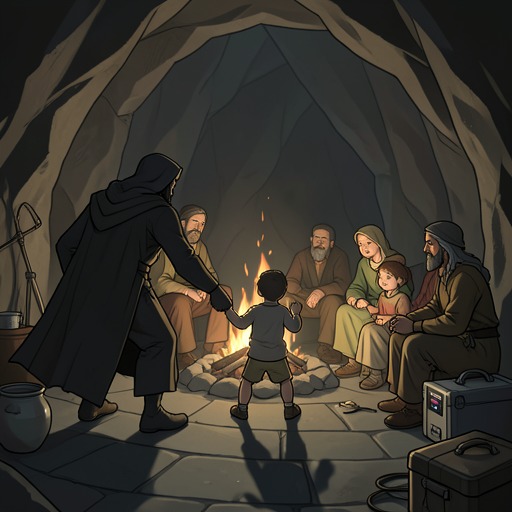
Jorgen traces the family’s arrangement to Nils Knudsen, his great-great-great-grandfather. A likeness of Nils, made about eight months after the family arrived in America, is one of the images Jorgen uses to explain the past. Nils had left Norway and wanted to bring his wife, Anna Sofie, with him. Seeing that the Sloopers’ planned vessel was too small, he sought what he considered insurance for his family’s passage. The bargain came at a cost: Nils, Anna Sofie, and Petra Mikkelsdatter remained in Queens, while the Sloopers continued upstate.
Jorgen describes the original surroundings as farmland and extensive forest. The land that became a park was bought for development by 1898, but its hills and pockets of caves still offered places for a large creature to hide. In Jorgen’s account, the landscape made Queens a suitable home for the being Nils had brought with the family. He uses the Norwegian terms Jotunn and Trolde for it, connecting the creature to the forests and mountains of the family’s homeland.
The agreement made Nils the creature’s caretaker. Its demand, Jorgen says, was a child. Nils eventually took his daughter Agnes Knudsdatter into the woods and left her in a cave. Jorgen confirms that Agnes’s father was the one who abandoned her there, directly connecting the family’s founding bargain to a specific act of parental betrayal. He also identifies a later drawing of Agnes, made from memory by his own father, among the family’s records.
The Archive of Children and Jorgen’s Guilt
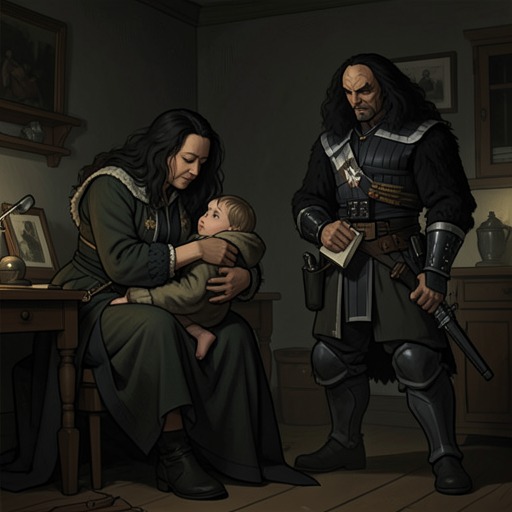
The den where Jorgen shows Apollo the family history has no windows; Apollo realizes that the openings have been removed and the walls reframed. More than one hundred pictures cover one wall. They form a rough chronology, progressing from sketches and charcoal renderings through daguerreotypes and photographs. Every subject is an infant, and none is older than a year. The archive makes the pact visible not as one distant sacrifice but as a repeating family practice.
Jorgen explains that the creature’s attempts to produce offspring fail. According to the terms of the pact, it feeds when those attempts fail, and the family must try again. He identifies the obligation as belonging to the men of the Knudsen line. Asked why the creature cannot raise its own young, he dismisses them as too ugly to love. His explanation presents the family’s conduct as a response to the creature’s demands, but does not remove the human responsibility that Apollo names: Jorgen acknowledges that he and the men before him have reason to feel guilty.
Jorgen reports that he hears Anna Sofie and sees her at night in the woods, where he says she appears with a blue light. He believes she will never forgive him. Two months before Apollo’s visit, he attempted suicide and survived. He describes having been treated in intensive care and says that even sedatives at Jamaica Hospital did not stop him from hearing her. He has difficulty eating solid food and drinks liquor with the nutritional supplement prescribed to him. These disclosures place his guilt in the present: the history is not only preserved in the pictures but persists, for Jorgen, as an accusation he cannot escape.
Fatherhood, Flight, and Death
Jorgen turns the conversation from inherited guilt to the question of what a parent would do for a child. Apollo says he would do anything, and Jorgen treats this answer as proof that a good father must be prepared to act without limit. The exchange brings the two men close in principle even as their actions have placed them on opposing sides. Jorgen has helped maintain a bargain that harms children; Apollo, searching for his own son, recognizes the force of parental devotion without accepting Jorgen’s account as an excuse.
Jorgen’s apparent confession also has a practical purpose. The front door has been left open and the front light turned on so that his son will know to run. Jorgen reveals that he did not tell Apollo the family history simply to unburden himself: he was trying to give his son time to escape. The admission recasts his openness as an act of concealment and care. Even while facing Apollo and the consequences of the pact, Jorgen is still directing his attention toward his son’s safety.
He asks Apollo for the knife. Apollo approaches and kills him with it. The kitchen timer sounds as the pot continues cooking, leaving the domestic scene in place around the sudden death. Apollo then backs away from Jorgen’s body. The act ends Jorgen’s attempt to protect his son in the room, though his earlier warning has already given the son an opportunity to flee.
Narrative Role and Significance
Jorgen’s significance lies in the collision between a father’s protective instinct and the violence of the family tradition he has inherited and continued. He does not deny the pact or the guilt attached to it; instead, he frames its demands through the absolute language of parental duty. His final effort to help his son makes that claim emotionally legible without resolving its moral contradiction. Protecting one child is inseparable, in his family’s history, from the abandonment of others.
The portraits provide the scene with its clearest measure of repetition. Their changing media register the passage of generations, but the children’s ages remain almost unnervingly constant. Against that silent record, Jorgen’s account of Nils and Agnes turns family legacy into a history of repeated choices, not merely a supernatural misfortune. Jorgen himself is both the keeper of that history and one of its participants. His death arrives not as an escape from responsibility but as the end of Apollo’s confrontation with the man who can explain how the bargain began and why it has continued.